Monday, May 27, 2013

Catching up to the Swedes

When I met up with Martin and Daniel in the BVI (whom I had first met in The Grenadines), they invited me to join them in sailing south to Trinidad before hurricane season, stopping to kite along the way.  I saw a very rare weather window to get back east without pounding into head seas - ten knot winds out of the south, with only two to three foot seas, so I headed for Antigua. This allowed for a comfortable 37 hour motor sail. A very severe electrical storm moved over me in the middle of the night, but I just put all my hand held electronics in the oven and went to the aft cabin (well away from the mast) and slept until it was over. I got into English Harbor about eleven PM the next night and was able to find a place to anchor without much difficulty.


After clearing in and filling the tanks, I join them and their friend Conny, who has his own boat and is also traveling in company with them, at Green Island, a beautiful anchorage and a good kiting site.


Green Island Anchorage

From Antigua, the three boats sail together for an overnight passage to Guadeloupe, leaving about five PM. It is a beat to get around the east side of the island, and we have to tack a few times. Conny and I arrive at Saint Francois in mid-morning. The twins' boat doesn't go to wind as well, and they end up taking two nights to get there - but they don't use their motor!

The four of us rent a car for two days and tour both halves of the country - Grande-Terre, the low lying island which is rich with sugar cane, and Basse-Terre, the mountainous half which has a lot of waterfalls and a volcano to climb. (Yes, I know that the names are backwards.) The volcano was quite interesting, and even though we were inside the clouds, we could see the steam belching from the crater, and if you got too close, it burned your eyes and lungs.
Daniel and Conny
Daniel and Martin
Pointe des Châteaux

It was fun hiking up to this cross after we had used it as a landmark at sea.

The Four Musketeers
A waterfall on Basse-Terre
The volcano is in lush cloud forest.

Very rugged terrain, also

Conny has a friend on the island, Marjorie, and on the weekend she and her friend Christine took us to a surfing beach one day, and a snorkeling site the next.

Daniel, Conny, Marjorie, Martin, and me
Marjorie, Conny, Daniel, Martin, and Christine


After Guadeloupe, we spent a day touring Marie-Galante, a beautiful bucolic island of rolling hills, unlike anything else I have seen in the eastern Caribbean. When I return, it will be even more enjoyable if I know more than twenty words of French!


There are many, many moulins on the island. This one was restored a couple decades ago.
Martin defying death above a blowhole
Yes, of course we took some mangos!


Sunday, May 26, 2013

Julie!


I am thrilled that Julie is going to fly down from Montreal for a visit in the Virgin Islands. I pick her up at the St Thomas airport and we spend the next week and a half touring the US and British Virgin Islands. We also meet up with a couple of my Swedish friends who I last saw on Union Island, along with some friends of theirs. And we spend some time with my friend Glenn, who is a charter skipper on a luxury 55 foot sailboat whose owners only spend about 10 days a month on board, leaving him free (aside from the endless maintenance) for the other 20 days. A highlight of the vacation is spending two days in our own private bay, with no other signs of civilization. I may have had more fun sometime, but I can't remember when!
Vive le Québec!

s'amuser avec des amis sur Sandy Cay:
 
Julie voulait voir le coucher du soleil, mais il n'était pas visible de l'ancrage, donc j'ai viré et a empanné en arrière et elle a pris cette belle photo.


Merci pour tous les merveilleux souvenirs, ma Cherie.

Thursday, April 4, 2013

Back in the BVI

I need to get to the BVI in early April in order to drop off the rest of Judy's things with her friend before the friend flies home. This is the only passage all the way from Grenada which requires an overnight. People sometimes ask me if I am afraid while sailing alone. No more than I was before, I guess. I'm reminded of a small time logger whose job I checked when I was a Ranger - he worked alone, cutting enough logs for a hitch and then skidding them out. I asked him if he was worried about safety, working out there all alone, and he said, in his laconic North Country way, "Well, at least if I get killed, I'll know whose fault it was."

I leave Montserrat at 7AM, and 27 hours later I clear in at Soper's Hole and start catching up on my sleep. The wind picked up around midnight, catching me with full sail and making for a boisterous but very fast ride the rest of the way. One of the highlights was seeing the lights from Saba, Statia, St Kitts, St Bart's, and St Martin all at the same time. So, after single handing 500 miles up the arc of the Lesser Antilles, I'm right back where I was ten months ago. I'm going to see if I can find some windsurfing here. I'll keep you posted...

Tuesday, March 26, 2013

Montserrat

Montserrat is a small island that was devastated by hurricane Hugo in 1989. Prior to that disaster, many musicians famous came here to record at George Martin's (of Beatles recording fame) AIR studios. He still keeps an estate here - it's on Penny Lane (seriously). Jimmy Buffet used to have a house here, which is where he wrote "Volcano". I'm sure he wishes he hadn't been so prescient, because in 1995 the Soufrière Hills volcano, which had been dormant for decades, became active. There were severe eruptions in 1997, forcing the permanent evacuation of the entire southern end of the island, which had been the center of the population and included the main port and the capital. The eruptions have continued intermittently since then, and the "exclusion zone" boundaries get moved back and forth slightly depending upon recent activity, but half of the island is still off limits. The current population of 5,000 is less than half of what it was in 1995.

Leaving Guadeloupe at Sunrise
The Soufrière Hiils volcano appears to sending out a bird (a Phoenix?) as I approach the island.

The steam on the right side of the photo is from the active volcano, which is shrouded in clouds most of the time. You can see fresh ash deposits on the grey slope to the left.

This alluvial fan of ash is covering what was once a golf course.

Some of the musicians who once recorded here donated a beautiful new community cultural center after the disaster. The "hall of hands" includes Elton John, Phil Collins, Mark Knopfler, Sting, Eric Clapton, and shown here, Paul McCartney.


Dolphins

While enroute from from Guadeloupe to Montserrat, I am treated to dolphins playing in my bow wave:


Dolphins Playing (link)


Saturday, March 23, 2013

Dominica

I leave St Pierre at the crack of dawn, and I start to sail out past the northern tip of Martinique, on my way to Dominica. All of these islands have capricious winds on the downwind side, but this is ridiculous - it goes from 20 knots on the port side to 20 knots on starboard, to calm, all within a minute! All I can do is keep the main sheeted tight and the foresail furled. To top it off, the swells are coming from the NE, and the wind is coming from the SSE, so I am already in ten foot swells (who ordered these - my GRIB files were predicting six to seven;-) Finally, the wind fills in from starboard, and I am absolutely flying across the water at speeds of eight knots plus. It's thrilling and invigorating, but I know that with the wind at 23 knots, I have too much sail up - when a squall starts approaching, it gives me incentive to reef, and then I am "only" making 7.5 knots. It's a great sail, until, of course, I get downwind of Dominica. But, hey, I love the way these islands are spaced out about 50 miles apart on a beam reach!

Mount Pelee never let me see the summit.
My flying friends will understand why the wind was so rough behind the mountain when they see the clouds in this photo ;-)
Approaching Dominica (da-min-EE-ka)
 
I arrive after Customs is closed, so I'll have to do it in the morning, but there is no problem with going ashore now. When I do clear in, the forms are done with carbon paper stapled in between! ( some of my younger readers may have to google "carbon paper" ;-) Such a difference from Martinique, where you clear yourself in a computer, which is what allowed me to check in without an outbound clearance from St Lucia and reestablish a paper trail.
 
These guys were playing drafts in Portsmouth, and I asked if I could take a picture of his shirt - President Obama has made the USA a lot more popular in the Caribbean.


Indian River

I hired Albert to take me up the Indian River. It's a national park, and a guide is required.
 
Maybe someone can tell me what type of flower this is - I just know that it's beautiful.
 
The second Pirates of the Carribean had a scene filmed here - where Jack Sparrow visits the voodoo priestess. Albert told me some interesting stories about it working on it.


Cricket

I was eating at the Purple Turtle, a beach restaurant, and listening to the cricket match. I asked a few questions of the waitress, who was obviously a big cricket fan, and she said that she and her friend were going down to Roseau tomorrow, and I should join them. I thought about it for a couple of minutes, and said "I cant wait!"

At this point, I need to back up - there are only a few test matches a year in the West Indies, and because Dominica is such a huge cricket country (and they have a beautiful new stadium), one of them is played here. This is world class cricket - the West Indies team is one of ten full members recognized by the ICC, and the only one that consists of more than one country (15, actually). A "test match" is traditional cricket, which can take up to five days to play. Basically, and this is for my American friends, it's like a two inning baseball game, but there are ten outs in each inning. A couple more things - there are only two "bases", not four, and a team mate is always on the other one, so that when you run, you trade places. There are no balls and strikes, and if you hit the ball, you don't have to run. There are several ways to make an out, but the two main ones are by letting a bowled ball (a pitch) hit the wicket, which consists of three stakes behind the batsman, or batting a ball which is caught in the air by a fielder. Now, the bowler (pitcher) doesn't throw from a mound - he gets about a 50 foot run towards the batsman before he delivers the ball. You'd be amazed at how long these batters can defend the wicket, while occasionally getting a hit, without making an out.

But wait, before we can get to the stadium, we need to take to bus from Portsmouth, in the north, to Roseau, the capital. An island "bus" is actually a mid sized van. The drivers fill them up before they leave, but there is "always room for more". We stop to pick up a couple more people, and it looks like they won't fit, but the passengers just get out and do what we used to call a "Chinese fire drill", and arrange themselves so that the girths of the passengers are equally distributed in the bench seats. Just as we are pulling away, a Mom and her baby come up - of course there's room! Another fire drill and seventeen people are snugly settled in the non-air conditioned van.

Petrolina and her daughter Aritha, both huge cricket fans


The upper photo shows Shane Shillingford the hometown hero from Dominica, in the process of bowling (left). He is a spin bowler, so when the ball hits the ground in front of the batsman, it does strange things, causing the batter to tend to tick the ball off or pop up weakly. (Oh yeah, I forgot to mention that you can bounce the pitches in.) In the close up below, you can see that there are two fielders right next to the Zimbabwe batsman. So, imagine taking the first and third basemen and having them play all the way down the lines, ten feet from the batter. That's what's going on here - except the batter isn't bunting - he's swinging away! "Coach, you want me to do WHAT?!?"

 
There were plenty of characters in the stands to get the crowd going!
 
The home team won very handily, ending the match on the third day - they didn't even need their second innings. Glad I went on Friday! The crowd got louder and louder as the final outs came. After the victory, there was a street party celebration scene outside the stadium:
 
I don't even know what these guys are - Carribean Vikings?
 
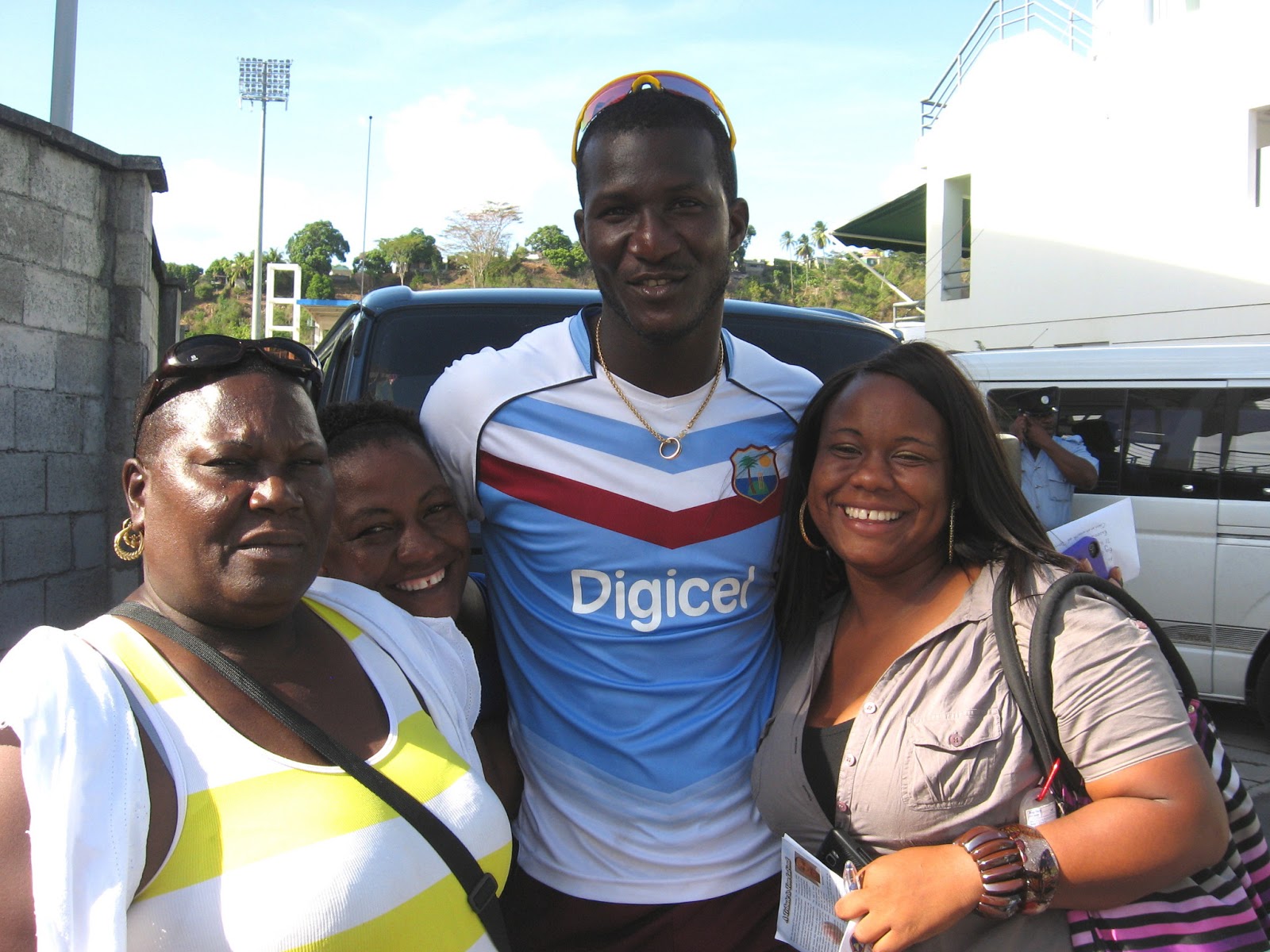
The ladies found the team Captain, Darren Sammy, for hugs and autographs.


Fort Shirley and Prince Rupert Bay

Dominica was the first island sighted on Columbus' second voyage. Also, the three ships bound for what would become Jamestown stopped here in Prince Rupert Bay in 1607. (Yes, that's very far out of their way - at that time, most of the ships still took the trade wind route.) And, in 1952, the first woman to sail solo across the Atlantic made port here after a very difficult passage from the Canary Islands in her 23 foot boat. Her name was Ann Davison, quite an interesting woman: http://www.wavetrain.net/lit-bits/336-ann-davison-transatlantic-on-felicity-ann


These are the guns the privateers used to sink and then plunder cruise ships.

On a more serious note, this is worthwhile reading.


Tuesday, March 19, 2013

If It's Monday, This Must be Martinique

I haven't left myself much time to spend in the next few islands, but I'm enjoying sailing and stopping overnight. I cleared into a small bay in southern Marinique yesterday, and this afternoon I went for a nice walk outside of St Pierre, in the northern part of Martinique. This town was completely destroyed be an eruption from Mt Pelee in 1902, killing almost 30,000 people. http://www.doyleguides.com/volcano1902.htm

The town with Mt Pelee in the Background

La Vierge Marie looks out over the Harbor

Beautiful Tropical Farmland